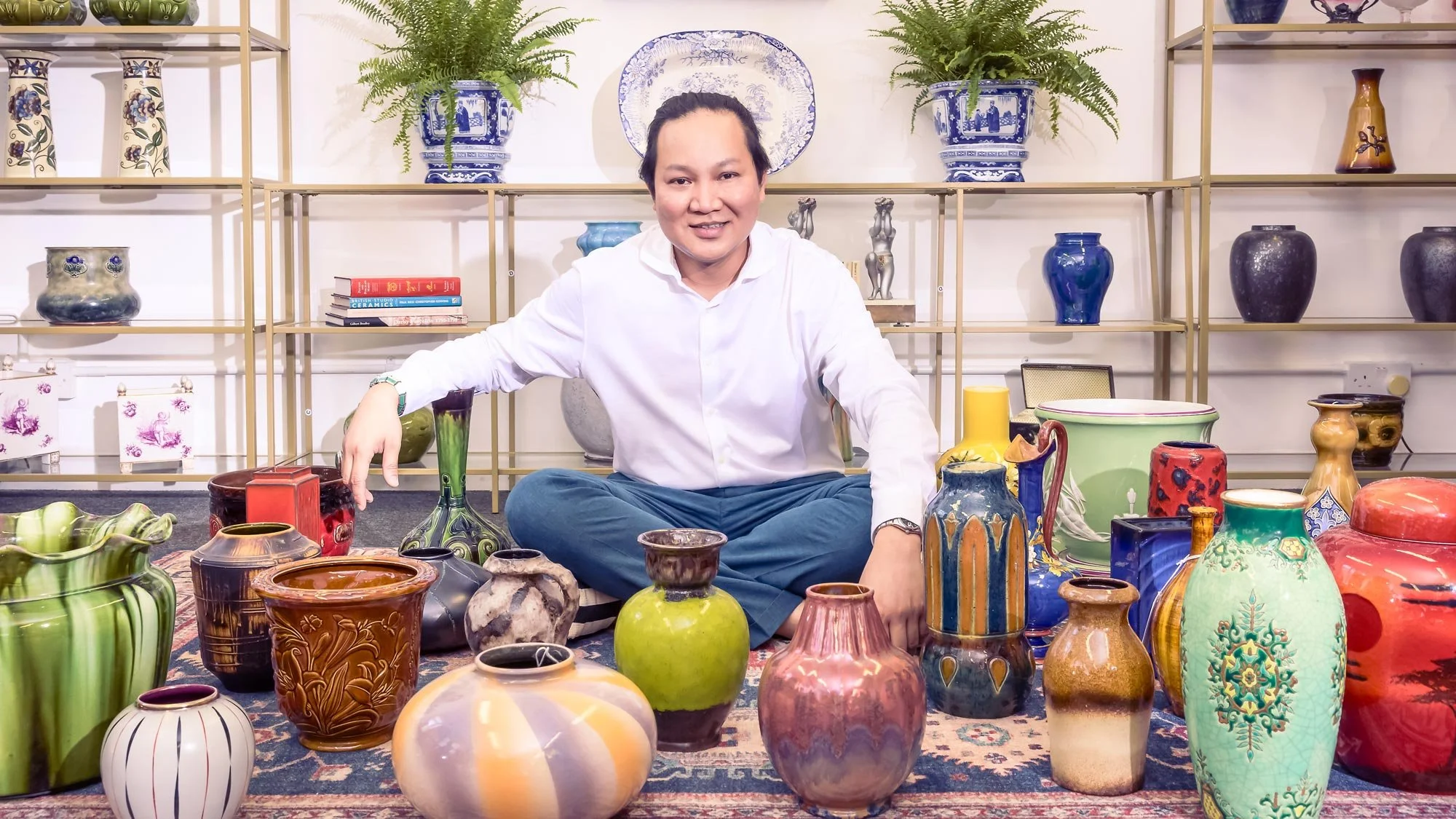
Where it began
It started with a small antiques shop in the village.
I walked in one day with no particular expectation and no real idea of what I might find. I wasn't looking for a particular maker or period. I was simply curious.
My first purchase was a beautiful emerald-green lamp with a silk shade. What struck me was the craftsmanship - something made years before that had endured, yet still felt timeless and capable of being enjoyed in a home today.
That first purchase opened the door.
Before long, I found myself discovering china and tableware: teacups, teapots and pieces made for the rituals of everyday life. I fell in love with Spode, and then Shelley, particularly its wonderful Art Deco designs. Each discovery seemed to lead naturally to another. Looking further back introduced me to New Hall, and with every new maker came another piece of history to learn.
I began to realise that collecting wasn't simply about owning old things. The pleasure was also in discovering - recognising a shape, turning a piece over to find a mark, learning about the people and factories that made it, and gradually understanding why certain objects spoke to me more than others.
My eye was developing long before I realised that was what was happening.
Objects are meant to be lived with
From the beginning, I have had one rule: objects are meant to be enjoyed and used.
However beautiful, old or finely made something might be, I have never believed that its only purpose should be to sit untouched behind glass. When I buy for myself, and now when I source for Curiosities, I think about how an object can become part of a home and continue to be enjoyed.
As my interest in china and decorative objects grew, I also began furnishing my home with antique furniture, what is often rather dismissively called "brown furniture". I fell in love with it.
The quality of the carpentry fascinated me. A George III dining table, a desk, a bureau: these were pieces made to be useful, but made with a level of craftsmanship that has allowed them to survive for generations.
Living with them also taught me new skills. I learned how to care for and polish old furniture, and began to understand the materials and workmanship in a way that simply looking at them could never have taught me.
Sometimes it is lovely simply to slow down and think about the life an old object has already had.
I often look at my George III dining table and wonder how many meals have been served around it. How many dishes have been placed upon it? How many celebrations, disagreements, announcements and ordinary family conversations has it witnessed?
We will never know most of those stories. But by continuing to use the table, rather than treating it simply as something old to be preserved, in a small way we add our own story to its history.
From collecting to curating
Inevitably, there came a point when I ran out of space.
If I wanted to continue discovering and buying, something had to leave to make room for something new. But by then, the way I was buying had also begun to change.
What had started instinctively was becoming more considered. I was beginning to understand my own style, what I liked, what I didn't, and why certain objects immediately caught my attention.
I wanted to learn more. I began reading books and magazines, learning the terminology and understanding the different periods, makers and movements. Then I discovered antique fairs.
That opened up an entirely new world.
Suddenly there seemed to be endless possibilities: rows of dealers, unfamiliar objects, names I had never encountered and pieces I might never have thought to look for. Every fair offered something new to discover and, very often, something new to learn.
As I made room at home, I began selling some of the pieces I had collected.
I still remember the feeling of making that first sale. Of course, there is satisfaction in selling something, but what stayed with me was something rather different: somebody else had seen what I had seen in that object.
Something I had found, chosen and appreciated had connected with another person enough that they wanted to take it home and make it part of their own surroundings.
That feeling has never really gone away.
When collecting became something more
As I learned more, the way I bought began to change - but the reason I bought never did. I simply learned to buy better.
I became more selective. I understood more about periods, makers, materials and craftsmanship, and gradually became more confident in trusting my own eye. But the starting point remained the same: does this object speak to me, and would I want to live with it?
I opened my first eBay shop and began selling there. A few months later, wanting somewhere physical to display my finds, I started looking for a cabinet in a local antiques centre and eventually found one at Antiques of Kingston.
That small step changed my perspective considerably.
Until then, antiques had largely been a personal world of collecting, learning, buying and selling. Being surrounded by other dealers made me realise that there was an entire industry behind this world I had fallen in love with. There were people who had built businesses and lives, around sourcing, researching and selling beautiful objects.
I began to wonder whether I could do the same.
The idea of making a living surrounded by beautiful things, with the constant possibility of discovering something I had never seen before, was enormously appealing. There would always be another maker to discover, another period to understand, another fair to visit and another object waiting to be found.
Eventually, though, I realised that if I genuinely wanted to make something of it, simply buying and selling wasn't enough. I needed to put myself out there.
I needed to create a brand that reflected my eye and my taste, and perhaps more importantly, become comfortable sharing the passion and knowledge behind the things I chose.
That wasn't something that came naturally to me. But my first sale had already taught me something important: somewhere out there was another person who saw what I saw in an object.
And if one person shared that appreciation, there would be others.
That realisation became the beginning of Curiosities by Simplicio.
Just the beginning
Curiosities by Simplicio is still very much at the beginning of its journey.
There is so much more to discover and even more to learn. There will be miles travelled to fairs and markets both close to home and further afield, new makers to encounter, unfamiliar objects to research and, inevitably, a few surprises along the way.
My eye will continue to evolve too. Tastes change, interiors change and the antiques market changes with them. My own preferences have already developed enormously since I first walked into that little village antiques shop, and I hope they will continue to do so. Part of the pleasure is never quite knowing what will capture your attention next.
The opening of my little studio, available to visit by appointment, feels like another important step. It gives me somewhere to bring these objects together, to live with them for a while and, most importantly, to share them with other people who see something in them too.
And who knows what comes next?
That, perhaps, is what I love most about this world. There will always be another object to discover, another story to uncover, another lesson to learn and another journey to make.
For now, I am simply enjoying the privilege of being surrounded by beautiful objects and seeing where they take me next.